


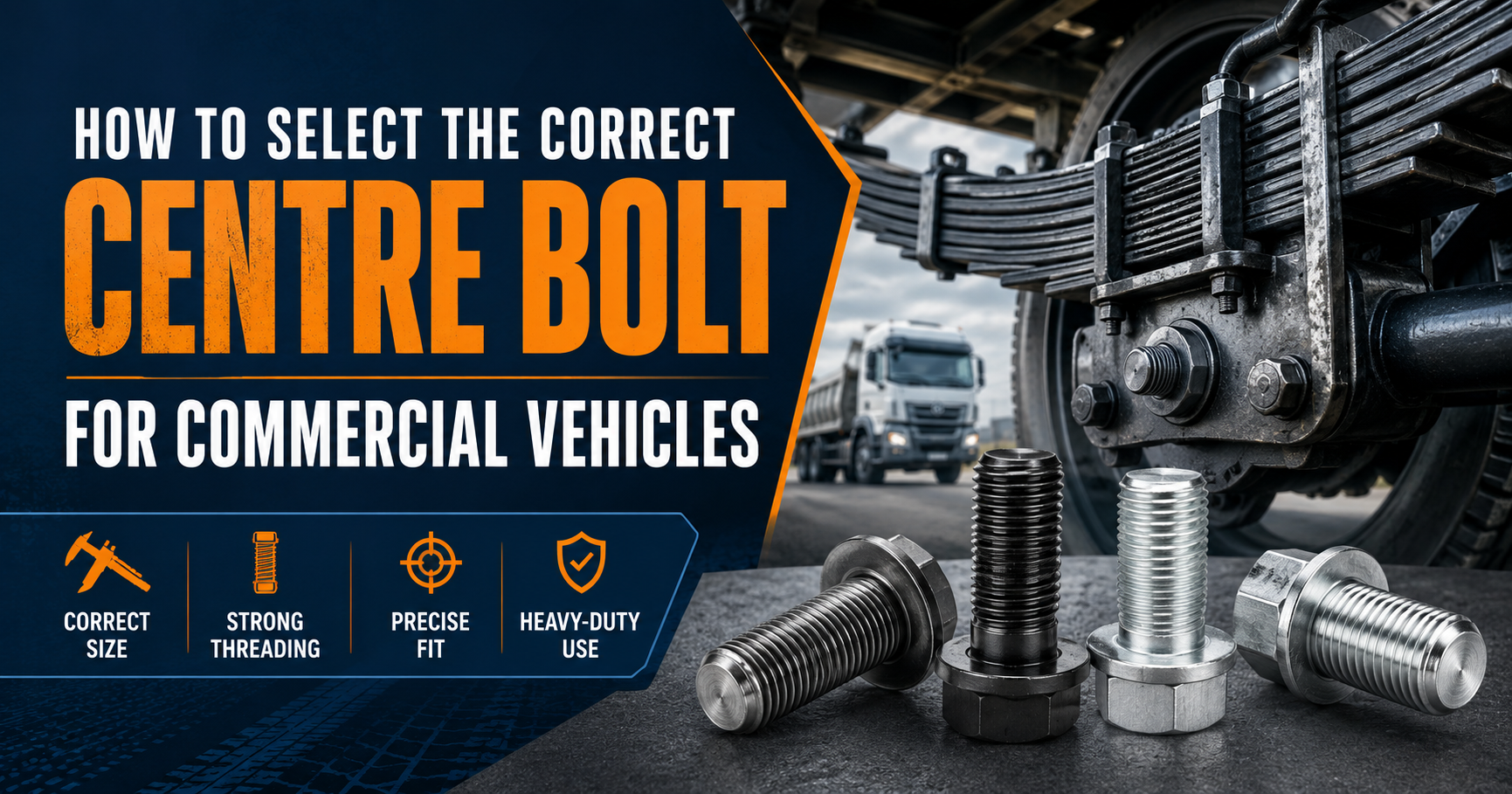
Centre bolts are small but critical components used in the leaf spring suspension systems of trucks, trailers, buses and other commercial vehicles. They hold the individual spring leaves together, maintain the alignment of the spring pack and help position the axle correctly over the suspension assembly.
Selecting an incorrect centre bolt can cause leaf spring movement, axle misalignment, suspension noise and premature damage to related components. Buyers and technicians must therefore check the bolt’s diameter, length, thread specifications, head design, material and strength before installation.
This guide explains how to select the correct centre bolt for commercial vehicles and what factors should be considered before placing an order.
What Is a Centre Bolt?
A centre bolt, also called a leaf spring centre bolt or spring centre bolt, passes through the central holes of all the leaves in a leaf spring assembly. A nut is tightened at the opposite end to keep the complete spring pack together.
The head of the centre bolt fits into a corresponding locating hole in the axle seat or spring mounting plate. This locating function helps position the axle correctly over the leaf spring.
Centre bolts are commonly used in:
- Trucks
- Trailers
- Buses
- Light commercial vehicles
- Agricultural tractors
- Construction machinery
- Mining vehicles
- Trolleys
- Heavy-duty suspension systems
Although the centre bolt does not independently support the entire vehicle load, its failure can affect the stability and alignment of the suspension system.
Understand the Function of a Centre Bolt
Before selecting a centre bolt, it is important to understand its role in the leaf spring assembly.
A properly selected centre bolt helps:
- Hold individual spring leaves together
- Maintain the alignment of the leaf spring pack
- Prevent sideways movement between spring plates
- Position the axle correctly over the spring
- Support proper U-bolt installation
- Simplify leaf spring assembly
- Maintain suspension stability
The centre bolt works together with U-bolts, spring plates and the axle seat. All these components must be correctly fitted to maintain secure suspension alignment.
Measure the Centre Bolt Diameter
The bolt diameter must match the centre holes in the leaf spring plates.
A bolt that is too thick will not pass through the spring pack. A bolt that is too thin may create unnecessary clearance and allow the leaves to move.
The diameter can be measured using:
- Vernier caliper
- Micrometre
- Bolt gauge
Measure the unthreaded shank whenever possible. Do not estimate the size only by looking at the old bolt.
The replacement bolt should match the original suspension specification unless a qualified technician recommends a different size.
Measure the Overall Length
The overall length must be sufficient to pass through the complete leaf spring pack and allow the nut to engage correctly.
When measuring the required length, consider:
- Total thickness of the spring pack
- Head height
- Washer thickness, where applicable
- Nut height
- Required thread engagement
- Any additional mounting component
A bolt that is too short may not provide enough thread engagement. A bolt that is too long may interfere with the axle seat or nearby suspension components.
The leaf spring pack should be compressed securely before determining the final required length.
Check the Thread Length
The threaded portion must be long enough to allow the nut to tighten the complete spring pack firmly.
Insufficient thread length can prevent correct tightening. Excessive threading may place the nut in an unsuitable position or reduce the required smooth shank area.
The thread length should account for:
- Compressed spring-pack thickness
- Washer thickness
- Nut height
- Required exposed threads
- Installation clearance
The nut should engage fully without reaching the end of the available thread before the spring pack is properly compressed.
Confirm the Thread Diameter and Pitch
Thread diameter and thread pitch must match the selected nut.
Thread pitch refers to the distance between adjacent threads. Commercial vehicle centre bolts may use coarse or fine threads depending on the suspension design.
Fine threads may allow more controlled tightening, while coarse threads can perform well in dusty and demanding workshop conditions.
Before ordering, confirm:
- Nominal thread diameter
- Thread pitch
- Thread direction
- Nut dimensions
- Required thread standard
Never force an incompatible nut onto a centre bolt. Mismatched threads can become damaged and may fail during tightening or vehicle operation.
Select the Correct Head Shape
The centre bolt head acts as a locating point between the leaf spring and the axle seat. Its shape and dimensions must match the corresponding recess or hole.
Common centre bolt head designs include:
Round Head Centre Bolts
Round heads are widely used in commercial vehicle leaf spring assemblies. The head fits into a rounded locating hole in the axle seat.
Square Head Centre Bolts
Square heads provide a firm locating surface and may help prevent rotation during assembly.
Hex Head Centre Bolts
Hex heads can be held or tightened using standard tools. They are used in selected automotive and industrial applications.
Socket or Allen Head Centre Bolts
Socket head bolts may be used where compact fitting or controlled tool access is required.
The correct head design must match the suspension assembly. A head that is too wide, narrow, tall or short may prevent the axle from seating properly.
Measure the Head Diameter
Head diameter is especially important because the centre bolt head must fit accurately into the locating hole of the axle seat or spring plate.
A head that is too large may not enter the locating hole. A head that is too small may create excessive movement and affect axle positioning.
Measure:
- Maximum head width
- Head height
- Shape of the head
- Diameter of the axle-seat locating hole
For a damaged or worn sample, measure the axle-seat hole as well rather than relying only on the old bolt dimensions.
Check the Head Height
The bolt head must extend sufficiently into the locating hole to position the axle correctly.
If the head is too low, it may not engage the axle seat properly. If it is too high, the axle may not sit flat on the leaf spring.
Incorrect head height can lead to:
- Uneven axle seating
- Incorrect suspension alignment
- U-bolt tightening problems
- Movement between the axle and spring
- Damage to the mounting plate
Always compare the head height with the depth of the corresponding locating hole.
Select the Correct Material
Centre bolts operate under clamping pressure, vibration and repeated suspension movement. The material should provide sufficient tensile strength, fatigue resistance and durability.
Commonly used materials may include:
- Carbon steel
- Medium-carbon steel
- High-carbon steel
- Alloy steel
- Automotive-grade steel
- Customer-specified steel grades
The correct material depends on the vehicle type, spring-pack thickness, axle load and working conditions.
Heavy-duty trucks and trailers generally require stronger centre bolts than light commercial vehicles.
Verify the Strength Grade
The centre bolt must withstand the force applied while compressing the leaf spring pack and the vibration experienced during vehicle operation.
An unsuitable bolt may:
- Stretch
- Bend
- Crack
- Lose its clamping force
- Break near the head
- Suffer thread failure
The bolt’s strength grade should match the vehicle or suspension manufacturer’s specification.
Buyers should not assume that a harder bolt is always better. Excessive hardness may make the bolt brittle. The material grade and heat treatment must provide a suitable balance of strength and toughness.
Consider Heat Treatment
Heat treatment helps improve the mechanical properties of centre bolts.
A controlled heat-treatment process may improve:
- Tensile strength
- Hardness
- Fatigue resistance
- Wear resistance
- Dimensional stability
- Overall service life
Poor heat treatment can result in inconsistent strength, deformation or premature failure.
Bulk buyers should ask manufacturers whether they perform hardness testing and maintain consistent heat-treatment conditions across production batches.
Choose a Suitable Surface Finish
Centre bolts may be exposed to water, mud, dust, road salt and temperature changes. A protective surface finish can help reduce corrosion.
Common finishes include:
- Black finish
- Zinc plating
- Phosphate coating
- Galvanised coating
- Oil coating
- Customer-specified finishes
The required surface finish depends on the operating environment and storage conditions.
Vehicles operating in coastal, wet or highly corrosive areas may require stronger corrosion protection.
Check the Leaf Spring Pack Thickness
The total compressed thickness of the leaf spring pack determines the required centre bolt length.
Spring-pack thickness may change when:
- A damaged leaf is replaced
- An additional leaf is installed
- A helper spring is added
- A heavy-duty suspension kit is fitted
- The complete spring assembly is rebuilt
- Worn leaves are replaced with thicker plates
Do not automatically reuse the previous centre bolt dimensions after modifying the spring pack. Measure the complete assembly again before ordering a replacement.
Match the Bolt to the Vehicle Application
Centre bolts are not universal. Different vehicles may require different diameters, lengths, threads and head profiles.
Before ordering, provide the manufacturer with:
- Vehicle make
- Vehicle model
- Manufacturing year
- Front or rear suspension position
- Leaf spring pack thickness
- Bolt diameter
- Overall length
- Thread length
- Thread pitch
- Head shape
- Head diameter
- Head height
- Material or strength requirement
- Surface finish
- Quantity required
For older, imported or modified vehicles, providing a physical sample or technical drawing can reduce the risk of dimensional errors.
Inspect the Original Centre Bolt
An old centre bolt can be useful as a sample, but it must be inspected carefully.
Check whether the original bolt is:
- Bent
- Stretched
- Corroded
- Worn at the head
- Damaged at the threads
- Previously modified
- Incorrectly fitted
- Broken near the head
A worn bolt may no longer represent its original dimensions accurately. Confirm critical measurements against the leaf spring and axle seat.
Inspect the Leaf Spring Centre Holes
The centre holes in the spring leaves should be aligned and free from excessive wear.
Check for:
- Enlarged holes
- Cracks near the centre
- Uneven alignment
- Rust and corrosion
- Burrs or sharp edges
- Damaged spring leaves
- Movement between plates
An oversized centre bolt should not be forced through damaged or misaligned holes. The spring assembly should be repaired or replaced as required.
Inspect the Axle Seat
The locating hole in the axle seat must match the centre bolt head.
Inspect the axle seat for:
- Enlarged locating hole
- Cracks
- Deformation
- Corrosion
- Dirt and debris
- Uneven contact surfaces
- Previous welding or repairs
A damaged axle seat may allow the spring pack to move even when a new centre bolt is installed.
Use the Correct Nut
The nut must match the bolt’s thread diameter, pitch and strength.
A suitable centre bolt nut should:
- Engage smoothly
- Provide full thread contact
- Resist stripping
- Maintain clamping pressure
- Match the required strength grade
Do not use nuts with damaged, rusted or crossed threads.
The nut should be tightened sufficiently to compress and hold the spring leaves together before the complete assembly is secured with U-bolts.
Do Not Use the Centre Bolt to Compress Loose Spring Leaves
A common installation mistake is using the centre bolt alone to pull a loose spring pack together.
Leaf springs store significant energy. Attempting to compress them only by tightening the centre bolt may overload or break the bolt.
A safer procedure is to:
- Align the spring leaves correctly.
- Use suitable clamps to compress the spring pack.
- Insert the centre bolt through the aligned holes.
- Install and tighten the nut.
- Release the clamps gradually.
- Check the final alignment.
The exact procedure should be performed by trained technicians using appropriate equipment.
Relationship Between Centre Bolts and U-Bolts
Centre bolts and U-bolts perform connected but different functions.
The centre bolt holds the spring leaves together and helps locate the axle. U-bolts clamp the complete leaf spring pack securely to the axle and mounting plate.
Loose U-bolts can place excessive stress on the centre bolt. This may cause the centre bolt to bend, shear or break.
Whenever a centre bolt is found damaged, technicians should also inspect:
- U-bolts
- U-bolt nuts
- Mounting plate
- Axle seat
- Leaf spring leaves
- Spring alignment
- Suspension brackets
Replacing the centre bolt without correcting loose or damaged U-bolts may result in repeated failure.
Common Reasons Centre Bolts Break
Centre bolt failure may occur due to:
- Incorrect bolt diameter
- Insufficient strength
- Poor-quality raw material
- Improper heat treatment
- Incorrect head dimensions
- Loose U-bolts
- Excessive vehicle loading
- Leaf spring misalignment
- Damaged axle seat
- Corrosion
- Over-tightening
- Incorrect installation
- Reusing a stretched bolt
Identifying the actual cause of failure is important before installing a replacement.
Signs of a Damaged Centre Bolt
Possible signs include:
- Misaligned leaf spring plates
- Sideways movement of spring leaves
- Unusual suspension noise
- Axle movement
- Uneven vehicle height
- Loose U-bolts
- Displaced spring pack
- Uneven tyre wear
- Visible bolt damage
- Cracks around the spring centre hole
The vehicle should be inspected promptly when these symptoms appear.
When Should a Centre Bolt Be Replaced?
A centre bolt should be replaced when:
- It is broken
- The bolt is bent
- Threads are damaged
- The head is worn
- Severe corrosion is present
- The bolt has stretched
- The spring pack is rebuilt
- Individual spring leaves are replaced
- The bolt no longer matches the assembly
- The axle has shifted due to suspension movement
Using a new centre bolt during leaf spring rebuilding can help maintain accurate alignment and secure assembly.
Custom Centre Bolts for Commercial Vehicles
Custom centre bolts may be needed for:
- Modified leaf spring packs
- Vintage trucks
- Imported commercial vehicles
- Agricultural machinery
- Special-purpose trailers
- Heavy-duty suspension systems
- Construction equipment
- Non-standard axle arrangements
For custom production, provide:
- Bolt diameter
- Overall length
- Thread length
- Thread pitch
- Head profile
- Head diameter
- Head height
- Material grade
- Required strength
- Surface finish
- Order quantity
A clear technical drawing or physical sample can help the manufacturer reproduce the required component accurately.
How to Choose a Reliable Centre Bolt Manufacturer
A dependable manufacturer should provide more than low pricing.
Evaluate whether the supplier offers:
- Suitable automotive-grade raw material
- Accurate head formation
- Consistent bolt dimensions
- Precise threading
- Controlled heat treatment
- Surface-finish options
- Custom manufacturing
- Dimensional inspection
- Hardness testing
- Strong packaging
- Reliable delivery schedules
Experienced centre bolts manufacturers in Ludhiana can support commercial vehicle workshops, spare-parts dealers, fleet operators, suspension manufacturers and exporters with standard and customised products.
Centre Bolt Selection Checklist
Before placing an order, confirm:
- Vehicle application
- Front or rear suspension position
- Bolt diameter
- Overall bolt length
- Thread length
- Thread pitch
- Head shape
- Head diameter
- Head height
- Leaf spring pack thickness
- Axle-seat hole dimensions
- Material grade
- Required strength
- Surface coating
- Matching nut
- Required quantity
Following this checklist can help prevent fitting problems and suspension misalignment.
Conclusion
Selecting the correct centre bolt for a commercial vehicle requires careful attention to its diameter, overall length, thread specifications, head dimensions, material, strength and surface finish. The bolt must fit accurately through the leaf spring pack while its head properly engages the locating hole in the axle seat.
For strong and accurately manufactured centre bolts, businesses can choose Benz Auto Corporation, a reliable manufacturer of fastening components for commercial vehicle suspension systems. Buyers searching for experienced centre bolts manufacturers in Ludhiana can approach Benz Auto Corporation for standard and customised centre bolts designed for trucks, trailers, buses, agricultural vehicles and other heavy-duty applications.
