


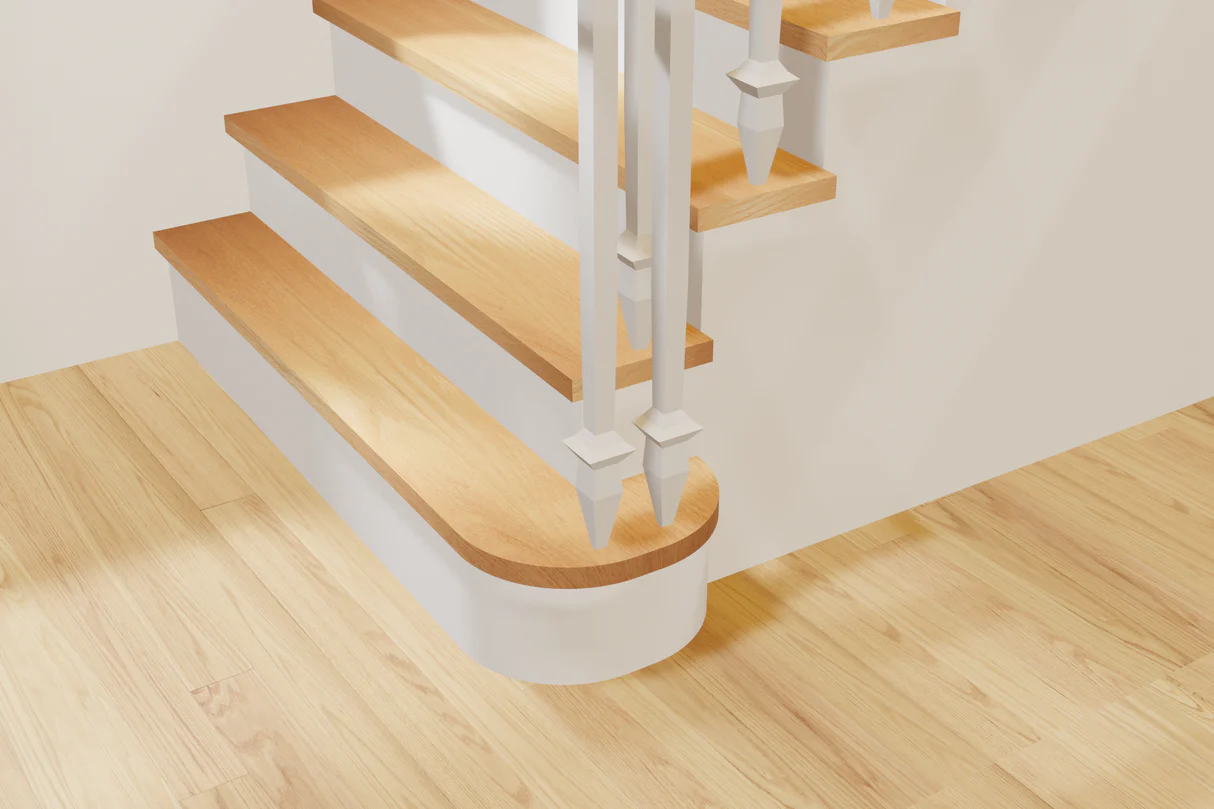
In a specification landscape where white oak has captured the design conversation and exotic species compete for attention at the premium tier, red oak occupies a position that its commercial ubiquity has caused some trade professionals to underestimate. It is the species that built the American hardwood flooring industry — the default specification across generations of residential construction that shaped the aesthetic expectations of more homeowners than any other single wood product. For flooring dealers, remodeling contractors, and design professionals evaluating Red Oak Stair Treads against the full range of available species options, the case for red oak is not a concession to budget constraints or a default to availability. It is a technically grounded specification decision supported by performance characteristics, finishing versatility, and a client recognition factor that no other domestic hardwood species can match at equivalent price points.
The Performance Foundation: Why Red Oak Earns Its Place
Red oak registers 1,290 on the Janka hardness scale — meaningfully harder than walnut at 1,010, harder than cherry at 950, and within a range that delivers genuine long-term wear resistance in residential stair tread applications without the finishing complexity that harder species like maple introduce. For trade professionals making species recommendations to clients whose primary concerns are durability, value, and a finished result that holds its appearance across years of residential traffic, red oak satisfies all three criteria with a consistency that more fashionable alternatives frequently fail to match at comparable price points.
The grain structure of red oak — open-pored, with a pronounced straight grain and visible medullary rays that are less dramatic than white oak’s quartersawn figure but present across all sawn profiles — gives the species a visual warmth and character that reads as genuinely hardwood in a way that uniform, closed-grain species do not. This is the visual quality that made red oak the dominant residential flooring species across the latter half of the twentieth century and that continues to make it the specification of choice for clients who want a staircase that reads as traditionally crafted rather than architecturally minimalist.
The availability and consistency of red oak in the commercial hardwood supply chain is a practical specification advantage that trade professionals operating under project timeline constraints appreciate directly. Red oak is grown across the eastern United States in volumes that make consistent grade availability, reliable lead times, and competitive pricing a structural feature of the supply chain rather than a variable that fluctuates with harvest conditions and market demand cycles in the way that less commonly grown species do.
Finishing Red Oak: The Specification Decisions That Determine the Outcome
Red oak’s open grain structure is the characteristic that most directly influences the finishing decisions that determine the visual outcome of a red oak stair tread installation — and the variable that most clearly differentiates the finishing approach appropriate for red oak from the approach that produces optimal results on white oak.
The open pores of red oak absorb stain at a different rate than the surrounding wood fibres — a differential absorption characteristic that produces a pronounced grain highlighting effect under dark stain applications. In traditional and rustic interior contexts where visible grain character is a design asset, this effect contributes to the warm, organic quality that clients selecting red oak for a traditionally styled staircase are typically seeking. In contemporary contexts where colour uniformity across the full tread width is the design priority, the same differential absorption requires management through grain filler application before staining — a preparation step that adds to the finishing process but produces the tighter, more uniform colour result that the design intent requires.
Natural and lightly toned finish applications on red oak produce the warm, amber-tinged result that is the species’ most recognisable aesthetic expression — the finish profile associated with the traditional American hardwood interior that red oak dominated for decades. For clients renovating homes where existing red oak flooring or millwork is being retained alongside a new staircase installation, matching the natural tone of existing red oak elements is a finishing challenge that red oak treads address more directly than any alternative species, eliminating the species incompatibility that creates finish matching problems when alternative species are introduced alongside existing red oak material.
Medium and darker stain applications — the grey-toned, brown-toned, and charcoal finish profiles that contemporary residential design preferences have made increasingly prevalent — produce results on red oak that require closer specification attention than equivalent applications on white oak. The open grain of red oak reads through medium and dark stains with more prominence than on white oak, producing a grain pattern emphasis that some clients find characterful and others find distracting depending on the design context. Presenting stained samples in the actual species and finish profile under consideration — rather than describing the result verbally — is the specification practice that eliminates the client expectation mismatches that stain colour descriptions alone cannot prevent.
Installation Considerations Specific to Red Oak Treads
Red oak stair treads share the dimensional specification, nosing profile, and moisture content requirements common to all hardwood tread installations — but present a small number of installation considerations that are specific to the species and worth incorporating into the installation practice of any contractor who specifies red oak regularly.
Adhesive selection for red oak treads requires attention to the tannin content of the species. Red oak contains a moderate tannin level that can react with certain adhesive formulations — particularly solvent-based adhesives with high pH — producing staining at the glue line that telegraphs through thin finish applications and is visible at the tread surface under certain lighting conditions. Moisture-cured urethane adhesives and specifically formulated hardwood tread adhesives that are evaluated for compatibility with tannic species avoid this reaction and produce clean glue lines that remain invisible under the finished tread surface across the service life of the installation.
Moisture content management is a specification priority for red oak treads that warrants explicit attention given the species’ movement characteristics. Red oak moves more significantly across seasonal moisture cycling than white oak — a function of its open grain structure and the absence of the tyloses cellular feature that contributes to white oak’s relative dimensional stability. Treads delivered and installed at moisture content values within three percentage points of the expected equilibrium moisture content of the installation environment minimise the post-installation movement that produces gapping, cupping, and surface checking in red oak treads installed without adequate moisture management.
Finishing schedule management on site-finished red oak treads requires awareness of the grain raising that water-based finish products produce on the open grain of red oak during initial coat application. A light abrasion between the first and second finish coats — after the initial coat has fully cured and the raised grain fibres have hardened — produces the smooth surface that subsequent coats require without the surface texture that unmanaged grain raising leaves in the finished tread surface under raking light conditions.
The Client Conversation: Positioning Red Oak Against the Alternatives
For trade professionals navigating client specification conversations where white oak is the opening request and budget or availability creates pressure to consider alternatives, the red oak specification deserves a more confident presentation than the default-to-budget framing that sometimes accompanies it.
Red oak is not a compromise specification when it is selected for the right project and the right client. It is the species that the American hardwood interior was built on — the material whose visual warmth, traditional character, and genuine hardness have made it the most widely installed hardwood flooring and stair tread species in American residential construction history. For clients renovating homes where red oak is already present, it is the only species that achieves true visual continuity with existing material. For clients whose design intent is a traditionally styled interior where the character of natural wood grain is a feature rather than something to be minimised, it is the specification that delivers that character most directly and most cost-effectively.
The specification conversation that positions red oak on its own merits — hardness, finishing versatility, traditional character, supply chain reliability, and value at premium quality tiers — serves clients better than one that presents it primarily as an alternative to something else.
Wood Stair Co supplies red oak stair treads in the grade consistency, moisture content standards, and dimensional specifications that flooring dealers, remodeling contractors, homebuilders, and design professionals require for premium residential stair installations — with a product quality standard built around the performance expectations of trade professionals who specify red oak as a deliberate choice rather than a default.
