


Choking emergencies tend to follow a recognizable pattern in the early seconds: the victim clutches their throat, struggles to speak, and the nearest person applies back blows or abdominal thrusts. What most people are not prepared for is what happens when those interventions fail and the victim loses consciousness entirely. Understanding how CPR differs in an unresponsive adult choking victim is one of the most important — and most frequently overlooked — distinctions in emergency response training. The window for effective action is narrow, and a response built on the wrong assumptions can cost irreplaceable seconds when they matter most.
Why This Scenario Catches Even Trained Responders Off Guard
Most first aid training devotes considerable attention to the conscious choking victim: back blows, abdominal thrusts, and the decision sequence for when each is applied. Far less time is given to what follows when those interventions do not succeed.
When a choking adult loses consciousness, the emergency shifts from an airway problem to a combined airway-and-cardiac emergency that requires an immediate change in approach. The responder who was moments ago applying abdominal thrusts to a standing person now has an unresponsive individual on the floor — and the correct response changes entirely at that moment. Without prior exposure to this specific transition, even people with active CPR certification often freeze or continue applying techniques that are no longer appropriate and that delay the intervention that could actually help.
What Is Happening Inside the Body
Understanding the physiological shift helps explain why the response must change so abruptly. A complete airway obstruction stops oxygen delivery to the lungs entirely. Blood oxygen levels fall rapidly, and the brain — acutely sensitive to deprivation — typically loses consciousness within one to two minutes of complete blockage.
As oxygen levels continue to fall, the heart will eventually arrest without oxygenated blood to sustain its function. At the point of unconsciousness, cardiac arrest may already be present or may be seconds away. The victim can no longer contribute independent respiratory effort, and abdominal thrusts cannot be effectively performed on someone with absent muscle tone and no upright posture to support the technique. The intervention must now address both the obstruction and the circulatory failure simultaneously.
The Protocol Modifications That Apply
When an adult choking victim becomes unresponsive, the response diverges from standard CPR in two essential ways.
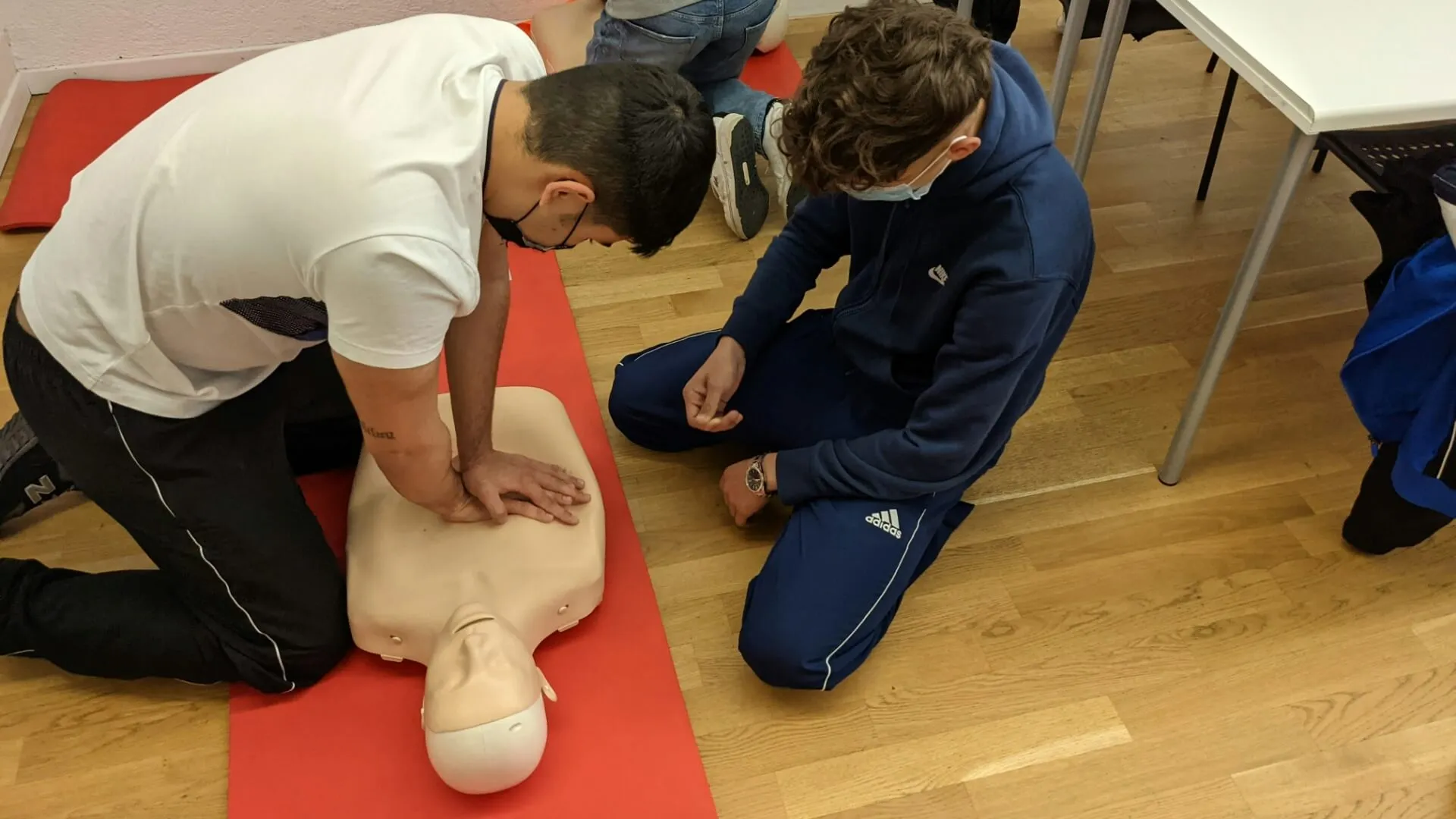
Chest compressions replace abdominal thrusts as the primary mechanical intervention. Beyond circulating blood, the downward force of compressions can physically dislodge a foreign object from the airway — making each compression purposeful on two levels at once. The victim should be carefully lowered to the ground and compressions started immediately at 100 to 120 per minute with full chest recoil between each one.
Before every attempt at rescue breaths, the rescuer opens the victim’s mouth and visually inspects for any visible foreign object. If one is identified, it should be carefully removed. Blind finger sweeps — inserting a finger into the throat without visual confirmation of an object — must never be performed, as this risks pushing the obstruction further into the airway. If rescue breaths do not produce visible chest rise, reposition the head and try once more before returning immediately to compressions. This modified cycle continues until the obstruction clears, the victim resumes breathing, or emergency services arrive and assume care.
Common Errors That Compromise the Outcome
Several predictable mistakes appear when responders encounter this scenario without specific preparation for it.
Continuing abdominal thrusts after the victim loses consciousness is the most frequent error. Effective abdominal thrusts require an upright torso with active muscular resistance to generate the inward and upward pressure needed to dislodge an obstruction. Applied to a supine, unresponsive person, they produce no useful force and delay the compressions that should have already begun.
Performing blind finger sweeps is a second serious error. Without visual confirmation of where an object is located, reaching into the throat is as likely to drive the obstruction deeper as it is to remove it.
Omitting the airway check between compression cycles is a third recurring gap. This visual inspection is not a secondary consideration — it is the mechanism by which a now-dislodged object is identified and removed. Skipping it means rescue breaths may continue to be blocked through cycles that could otherwise succeed.
Building the Mental Framework Before It Is Needed
The particular difficulty of this scenario is that it escalates quickly and demands a deliberate shift in approach — a shift that is genuinely hard to execute under stress without prior mental rehearsal.
The cue is precise: the moment the victim becomes unresponsive. That single event signals the end of abdominal thrusts, the careful lowering of the victim to the floor, activation of emergency services, the start of chest compressions, and a visual airway check before every rescue breath attempt. Mentally rehearsing this sequence — including the specific moment that triggers the protocol change — builds the pattern recognition that holds under genuine emergency conditions and replaces hesitation with purposeful action.
Preparation Is the Difference Between Hesitation and Action
A choking emergency that progresses to unconsciousness is survivable — but the outcome depends almost entirely on whether the nearest person knows the correct modified response and executes it without delay. That readiness comes only from training that covers not just the common scenarios but the ones that escalate in ways most people never anticipate until they are standing in front of them.
Simple CPR offers comprehensive online CPR and first aid training that addresses critical advanced scenarios, including adult choking that progresses to unconsciousness, airway management under CPR conditions, and the protocol modifications that apply. Visit their website to find a course that prepares you for the emergencies most people are not ready for — until they are.
